Introduction
Hugh Ross presents himself as a bridge between faith and science. As an astronomer with a PhD from the University of Toronto[1] and founder of the apologetics ministry Reasons to Believe, Ross occupies a unique position in the origins debate. He is neither a young-earth creationist who dismisses modern cosmology nor a secular scientist who rejects the divine. His book Improbable Planet: How Earth Became Humanity's Home promises readers the best of both worlds: a scientifically literate defense of creation that embraces the age of the universe and the findings of modern astronomy.
This promise has obvious appeal. Many Christians feel caught between their faith and what they learned in science class. Ross offers them a way out. He says you can accept the Big Bang, an ancient Earth, and the general timeline of cosmic history while still believing that God designed it all. For readers tired of the shouting match between atheists and fundamentalists, Ross seems like a reasonable voice in the middle.
The problem is that Ross's methodology does not hold up under scrutiny.
Improbable Planet makes a simple argument: Earth is so finely tuned for human life, so dependent on an impossibly precise sequence of cosmic and geological events, that random chance cannot explain our existence. A Creator must have orchestrated it all. Ross supports this claim by citing scientific studies, quoting astronomical data, and walking readers through billions of years of Earth's history. He writes like a scientist because he is one.
But a pattern emerges when you look closely at how Ross handles his sources. He embraces scientific consensus when it supports his conclusions. He dismisses or reinterprets that same consensus when it does not. He treats the scientific community as authoritative on the age of the universe but waves away their conclusions about abiogenesis and evolution. He positions himself as a defender of rigorous inquiry, then tells readers that "supernatural causality warrants respectful consideration by scientists, rather than immediate and unquestioning dismissal."
The same pattern appears in his treatment of scripture. Ross claims to take the Bible seriously, yet his interpretation of Genesis requires readers to accept that the Hebrew word for "day" does not actually mean a day. He applies special interpretive rules to certain passages while treating others as plainly literal. When challenged, he offers no consistent method for determining which scriptures require reinterpretation and which should be read at face value.
This creates a closed loop. Ross becomes the sole arbiter of which science to trust, which scriptures to reinterpret, and how the two fit together. Readers are not invited to evaluate the evidence independently. They are asked to trust Ross's judgment about what the data really means.
This paper examines that pattern in detail. We will look at Ross's handling of the Hebrew text, his selective use of scientific literature, and the logical problems with his core arguments. We will also address the probability claims at the heart of Improbable Planet, showing why the "fine-tuning" argument fails when you understand how probability actually works at cosmic scales.
The goal here is not to attack Ross personally or to dismiss faith as irrational. The goal is intellectual honesty. If Ross claims to follow the evidence wherever it leads, his methodology should be consistent. If he claims to respect both science and scripture, he should apply the same standards to both. What we find instead is a framework built on convenience: accept this evidence, reject that evidence, interpret this passage, take that passage literally. The common thread is not rigor. It is whatever supports the conclusion Ross already holds.
This matters beyond the origins debate. When interpretation has no consistent rules, anyone can claim special insight. Ross's approach teaches readers to distrust their own reading of scripture and to selectively dismiss scientific findings. It creates exactly the kind of gap that manipulative teachers and cult leaders exploit: "You cannot understand this on your own. You need me to tell you what it really means."
We can do better than this. We can hold faith and science to the same standard of honesty. We can demand consistent methodology from those who claim to speak for both. That is what this paper attempts to do.
The Interpretation Problem
If the Bible does not mean what it plainly says, who decides what it actually means?
This question sits at the heart of Ross's methodology, and he never answers it satisfactorily. In Improbable Planet, Ross assumes a framework where the creation days of Genesis represent long ages rather than literal 24-hour periods. He does not defend this interpretation in the book itself. Instead, he refers readers to his earlier work, Navigating Genesis. The billions of years required by his cosmic timeline simply cannot fit into a plain reading of Genesis 1, so Ross reinterprets the text to match his conclusions.
The Hebrew word at the center of this debate is "yom," which appears throughout the Old Testament.[2] In Genesis 1, God creates the world in six "yoms" and rests on the seventh. Ross argues that "yom" can mean an extended period of time, not just a 24-hour day. This is technically true. Like the English word "day," the Hebrew "yom" has a range of meanings. We say "back in my grandfather's day" without meaning a specific 24-hour period.
But context matters. When "yom" appears with a number in Hebrew scripture, it consistently refers to a literal day.[3] Consider these examples:
- "On the seventh day God had finished his work" (Genesis 2:2)
- "For six days the cloud covered the mountain, and on the seventh day the Lord called to Moses" (Exodus 24:16)
- "On the first day you shall remove leaven from your houses" (Exodus 12:15)
- "The waters flooded the earth for a hundred and fifty days" (Genesis 7:24)
- "On the third day Abraham looked up and saw the place in the distance" (Genesis 22:4)
In each case, "yom" with a number means an ordinary day. This pattern holds across hundreds of uses in the Hebrew Bible. The construction "evening and morning, the first day" in Genesis 1 follows this exact pattern. Ross must explain why Genesis 1 deserves special treatment when the same grammatical construction means a literal day everywhere else in scripture.
He does not provide this explanation. Instead, he assumes his interpretation and moves forward. Readers who accept his framework do so on trust, not on a consistent hermeneutic.
This creates a deeper problem. If "day" can be reinterpreted to mean "age" in Genesis, what stops us from reinterpreting other inconvenient passages? Where do we draw the line between metaphor and plain meaning? Ross offers no criteria. He simply makes the call and expects readers to follow.
The Danger of Arbitrary Interpretation
Throughout history, teachers have positioned themselves as the sole interpreters of sacred texts. "You cannot understand this on your own," they say. "You need my special insight to know what the words really mean." This is exactly how manipulative leaders gain control over their followers. They insert themselves between the text and the reader, making themselves indispensable.
Ross may not intend this outcome. But his methodology opens the door to it. When scripture means whatever the interpreter says it means, the interpreter becomes the authority rather than the text itself.
The Death Problem
The interpretation problem also creates theological contradictions within Ross's own framework. Ross accepts biological evolution as part of God's creative process. He believes life developed over billions of years through mutation and natural selection. This sounds reasonable until you consider what evolution requires: death. Lots of it.
Natural selection works because organisms die. The less fit die more often. The more fit survive to reproduce. Over millions of generations, this process produces new species. Death is not incidental to evolution. It is the engine that drives it.
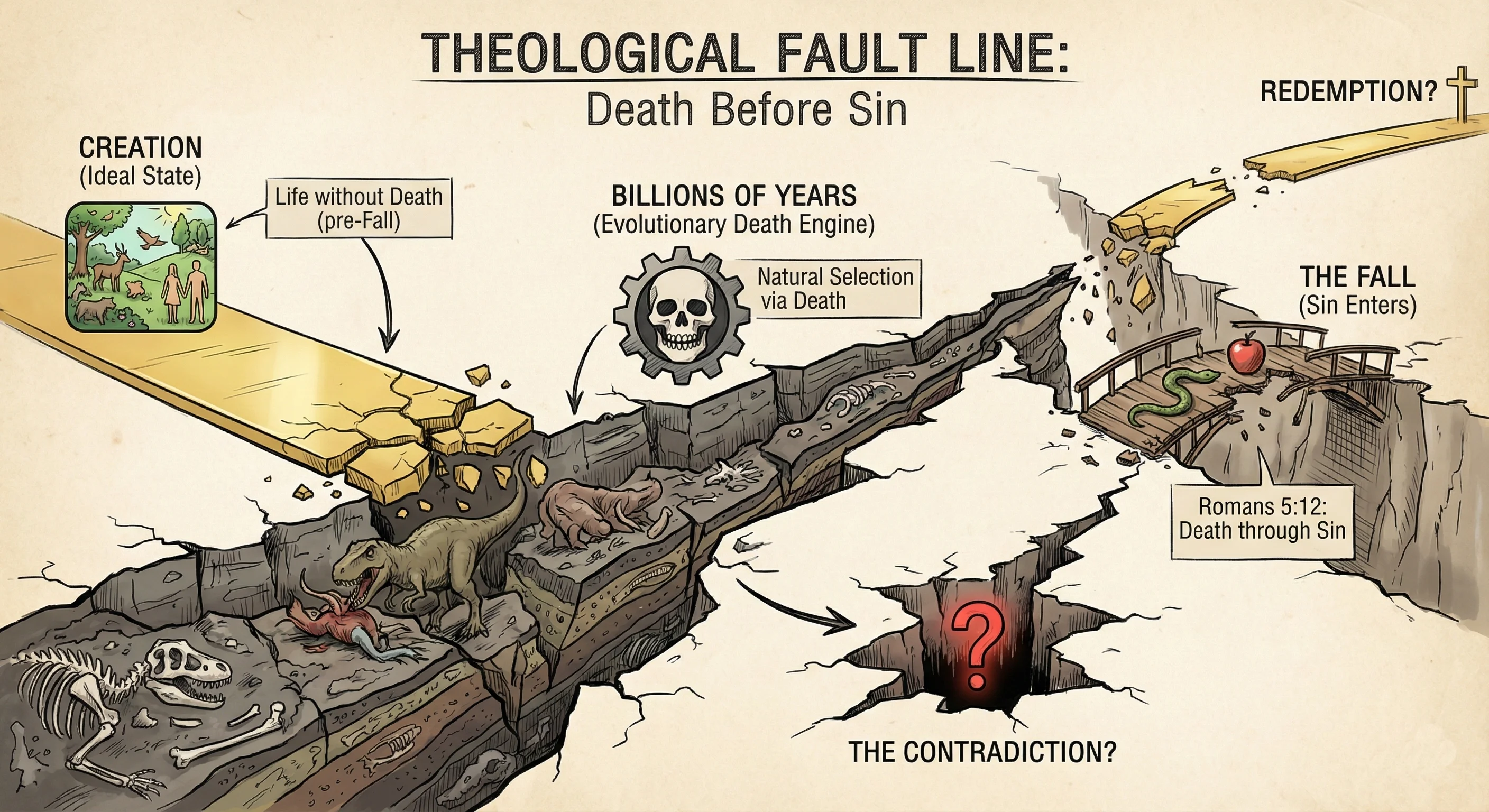
But according to the Bible, death entered the world through human sin. Genesis 3 describes the curse that followed Adam and Eve's disobedience. Romans 5:12 states plainly: "Sin entered the world through one man, and death through sin." The entire framework of Christian redemption depends on death being an intruder, something wrong that Christ came to defeat.
If Ross accepts billions of years of evolution before humans existed, he accepts billions of years of death before the Fall. Creatures suffered, struggled, and died for eons before Adam took his first breath. This is not a minor tension. It undermines the biblical narrative of death as a consequence of sin.
Ross does not resolve this contradiction in Improbable Planet. He describes the progression of life through geological ages, celebrates the "fine-tuning" that allowed complex organisms to emerge, and apparently sees no conflict with his stated commitment to biblical authority. But the conflict exists whether he acknowledges it or not.
The pattern here is consistent. Ross interprets scripture to fit his scientific conclusions, not the other way around. When the plain reading conflicts with his timeline, he reinterprets. When theological implications become uncomfortable, he ignores them. The common thread is not fidelity to the text. It is convenience.
Scientific Cherry-Picking
Ross presents himself as a scientist who follows the evidence. He holds a PhD in astronomy.[1] He cites peer-reviewed journals. He speaks the language of data and discovery. This credibility is central to his appeal. Readers trust him because he appears to approach these questions with scientific rigor.
But which evidence does Ross follow? And from when?
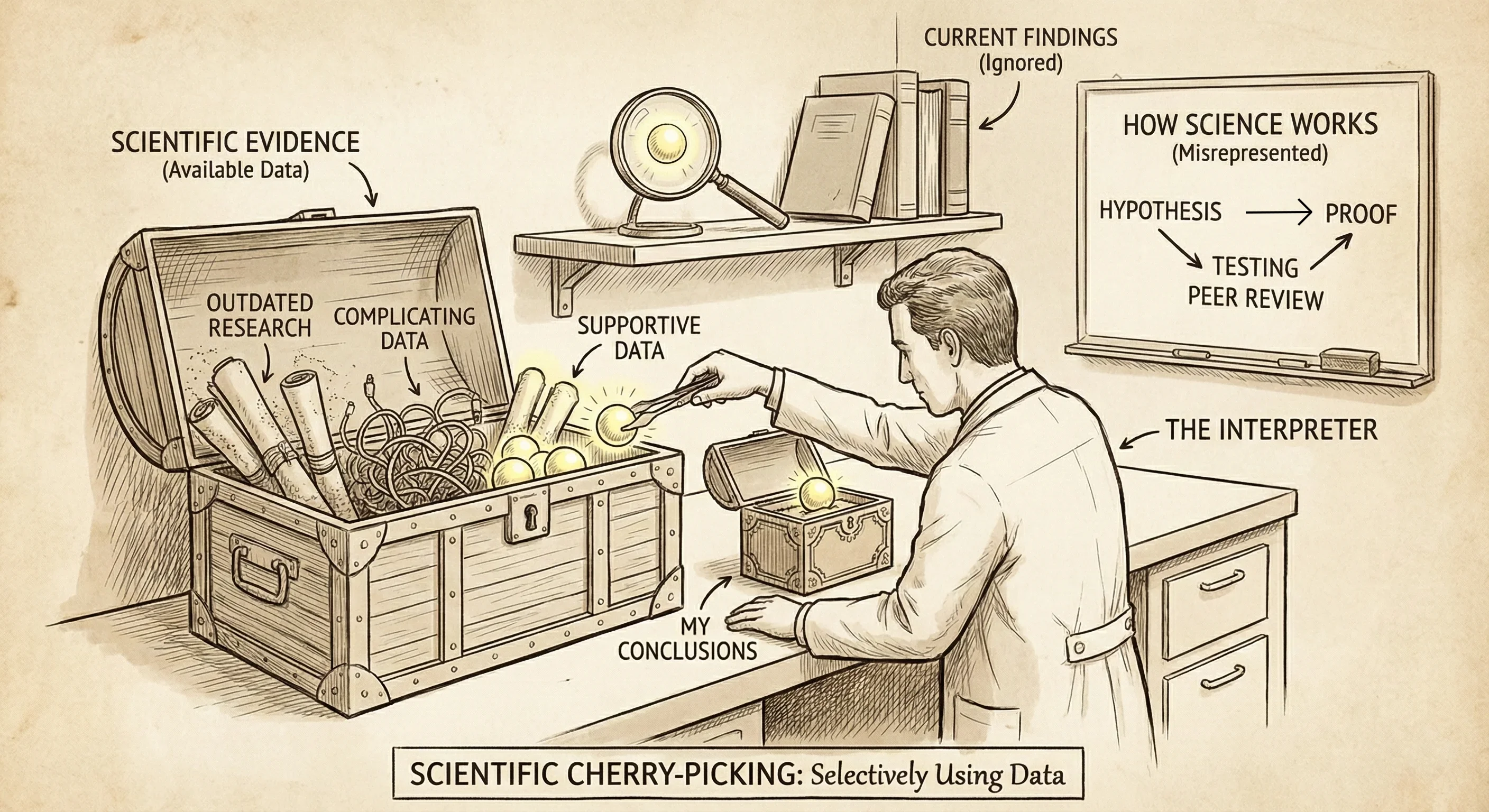
A careful reading of Improbable Planet reveals a troubling pattern. Ross selectively uses scientific data, favoring sources that support his conclusions while ignoring or dismissing those that do not. He relies on outdated research when current findings would complicate his argument. He makes authoritative claims in fields where he has no expertise. And he misrepresents how science actually works when discussing the origin of life.
The Outdated Data Problem
Ross's citations tell a revealing story. Throughout Improbable Planet, he references studies from decades past when more recent research exists. For example, when discussing models of the Moon's formation, Ross cites "dynamical models developed during the 1960s and 1970s" that "utterly failed to account for the Moon's existence." This framing serves his argument that the Moon's existence requires supernatural explanation. But lunar science has advanced enormously since the 1970s. The giant-impact hypothesis is now the favored model among astronomers, supported by isotopic evidence and advanced computer simulations.[4] Ross either does not know about these advances or chooses not to mention them.
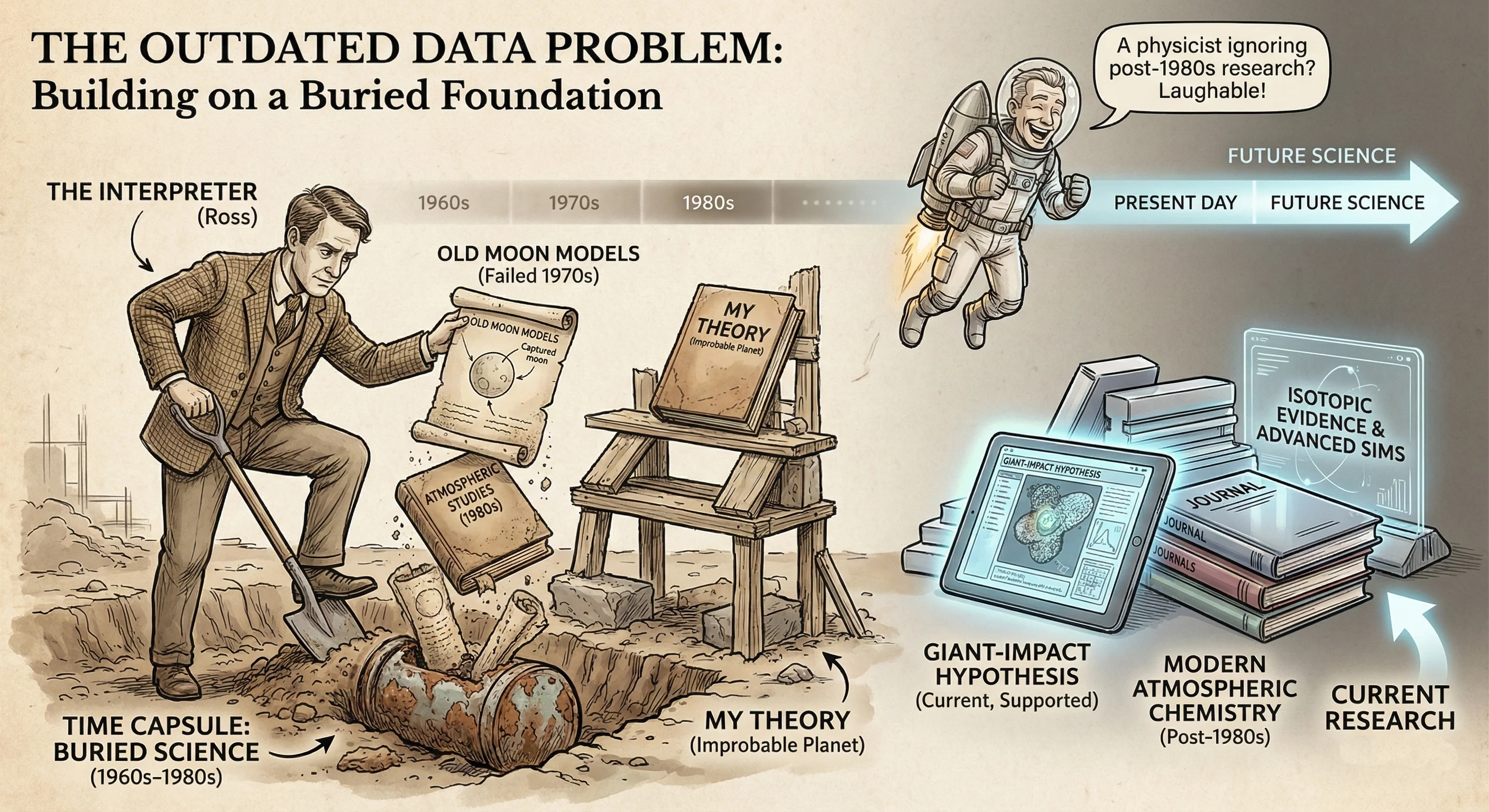
The same pattern appears in his discussion of atmospheric chemistry and early Earth conditions. Ross cites work from the 1980s on carbon dioxide levels and greenhouse effects while treating more recent findings selectively. When new research supports his position, he presents it eagerly. When it complicates his argument, it disappears.
Why would a scientist rely on data from forty or fifty years ago? Scientific understanding advances. The astronomy Ross practiced in graduate school has been transformed by new instruments, new observations, and new theoretical frameworks. A physicist who ignored everything published after 1980 would be laughed out of any serious conference. Yet Ross treats decades-old research as authoritative when it serves his purposes.
The Abiogenesis Strawman
Ross's treatment of life's origin provides a case study in misrepresentation. In Appendix B of Improbable Planet, he writes:
"No one has come close to showing that even the simplest living entity could possibly assemble itself."
This statement is technically true in the narrowest sense and deeply misleading in context. Science does not propose that a cell "assembled itself" from nothing in one dramatic leap. This is a strawman, a misrepresentation of the opposing view designed to make it easier to knock down.
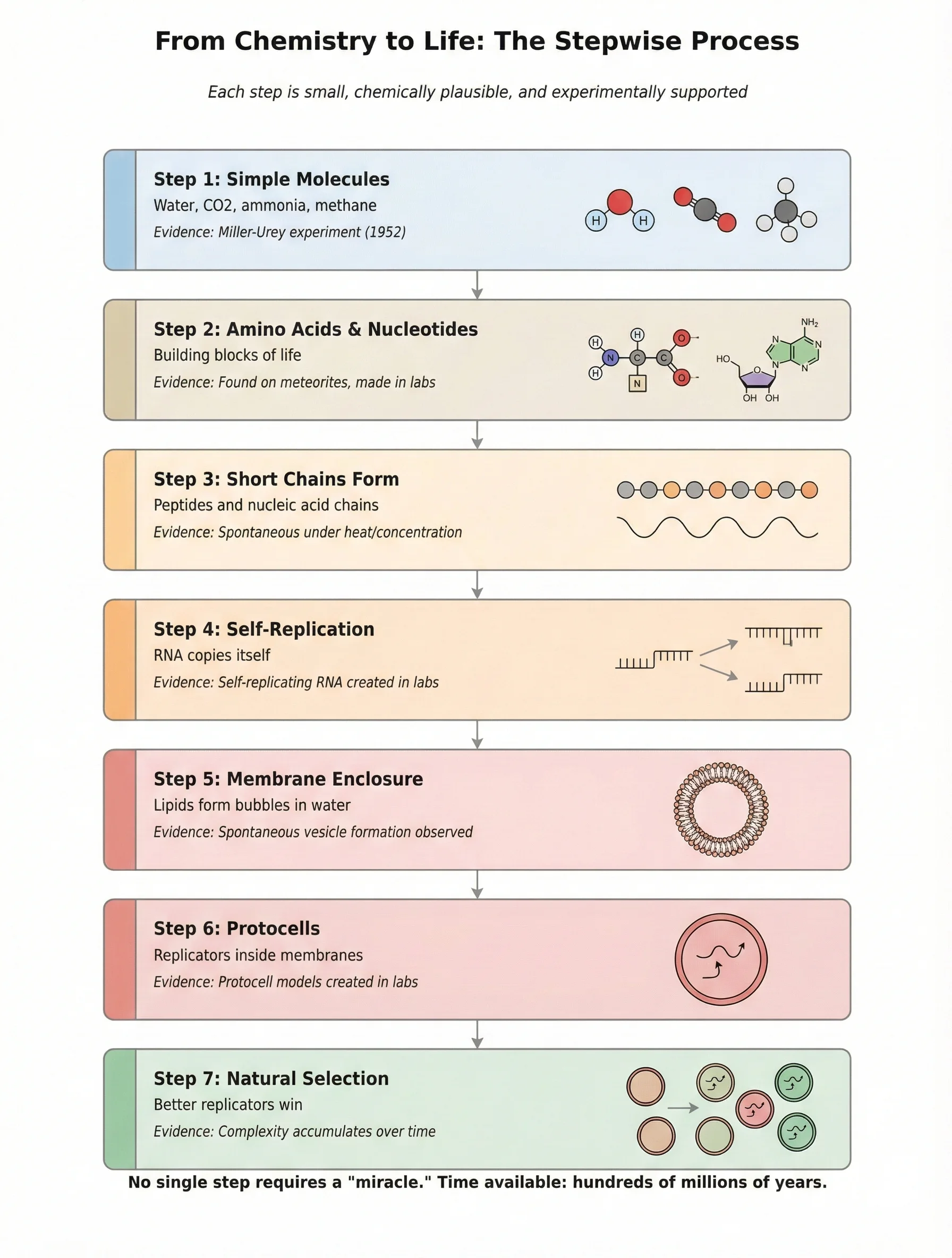
The scientific model for life's origin, called abiogenesis, proposes a long series of incremental steps:
- Simple molecules form from basic chemical elements
- These simple molecules combine into more complex organic molecules
- Complex molecules develop the ability to self-replicate
- Self-replicating molecules become enclosed in primitive membranes
- These protocells develop more sophisticated internal chemistry
- Eventually, true cells emerge
Each step is small. Each step is chemically plausible. Scientists have demonstrated many of these individual steps in laboratory conditions. Researchers have created self-replicating RNA molecules,[5] observed the spontaneous formation of cell-like membranes from simple lipids,[6] and shown how metabolic cycles can run without enzymes. The full chain from chemistry to life has not been demonstrated end-to-end, but many links in that chain have been forged.
Ross knows this. He must know this. The literature on abiogenesis is extensive, and Ross cites some of it in his footnotes. Yet he frames the question as though scientists claim a complete cell appeared from nothing, then points out that this has never been demonstrated. This is like criticizing a mountain climber for failing to teleport to the summit while ignoring the miles of trail they have already covered.
The "Junkyard Tornado" Fallacy
This is the idea that claiming life arose naturally is like claiming a tornado swept through a junkyard and assembled a Boeing 747. The image is vivid and memorable. It is also completely wrong. No one claims life assembled all at once from random parts. The actual model involves billions of years of incremental chemistry, building complexity step by step.
Speaking Outside Expertise
Ross holds a doctorate in astronomy. This is a legitimate credential. He is qualified to speak about stars, galaxies, cosmology, and the large-scale structure of the universe. Improbable Planet covers these topics competently.
But the book also makes authoritative claims about organic chemistry, biochemistry, molecular biology, paleontology, and geology. Ross discusses polypeptide formation, amino acid chemistry, protein folding, and cellular machinery with the same confident tone he uses for astronomy. The problem is that he has no credentials in these fields.
This matters because the details matter. Origin-of-life chemistry is extraordinarily complex. The behavior of amino acids, the formation of peptide bonds, the conditions under which organic molecules concentrate and react: these are specialized topics that require specialized knowledge. An astronomer who reads a few papers on biochemistry does not become a biochemist.
When Ross makes definitive statements about polypeptide formation or the impossibility of natural abiogenesis, he is speaking outside his expertise. He may be repeating what other critics have said. He may be accurately summarizing certain papers. But he is not qualified to evaluate the primary research or to assess competing claims in the field.
This is not an ad hominem attack. Ross's character is not the issue. The issue is epistemic humility. Scientists routinely defer to colleagues in other fields because they know the limits of their own knowledge. A brilliant neurosurgeon would not presume to lecture a particle physicist on quantum field theory. But Ross writes as though expertise in one scientific domain grants authority across all of them.
The pattern across these examples is consistent. Ross uses science as a prop. When scientific findings support his argument, he cites them with enthusiasm. When they complicate his argument, he cites outdated versions, misrepresents them, or speaks with false authority in fields he does not understand. This is not following the evidence. This is selecting the evidence.
The Numbers Don't Lie
The core argument of Improbable Planet rests on probability. Ross claims that Earth is so finely tuned, so dependent on an impossibly precise sequence of events, that random chance cannot explain our existence. The numbers are simply too extreme. A Creator must have stacked the deck.
This argument has intuitive appeal. When Ross lists dozens of factors that had to be "just right" for life to exist, when he describes the narrow window of habitability and the precise conditions required for complex chemistry, readers feel the weight of improbability pressing down. Surely all of this cannot be coincidence.
The Fatal Flaw
But the argument fails when you understand how probability actually works at cosmic scales.
Ross exploits a gap between human intuition and mathematical reality. Our brains evolved to handle the probabilities of everyday life: the chance of rain, the odds of finding food, the likelihood that a predator lurks nearby. We did not evolve to grasp numbers in the billions and trillions. Ross takes advantage of this limitation.
Understanding Scale
Before we can evaluate probability claims, we need to understand the scale of the universe. This is harder than it sounds. The numbers involved are so large that they lose meaning. A million, a billion, a trillion: these words slide past without registering their actual differences.
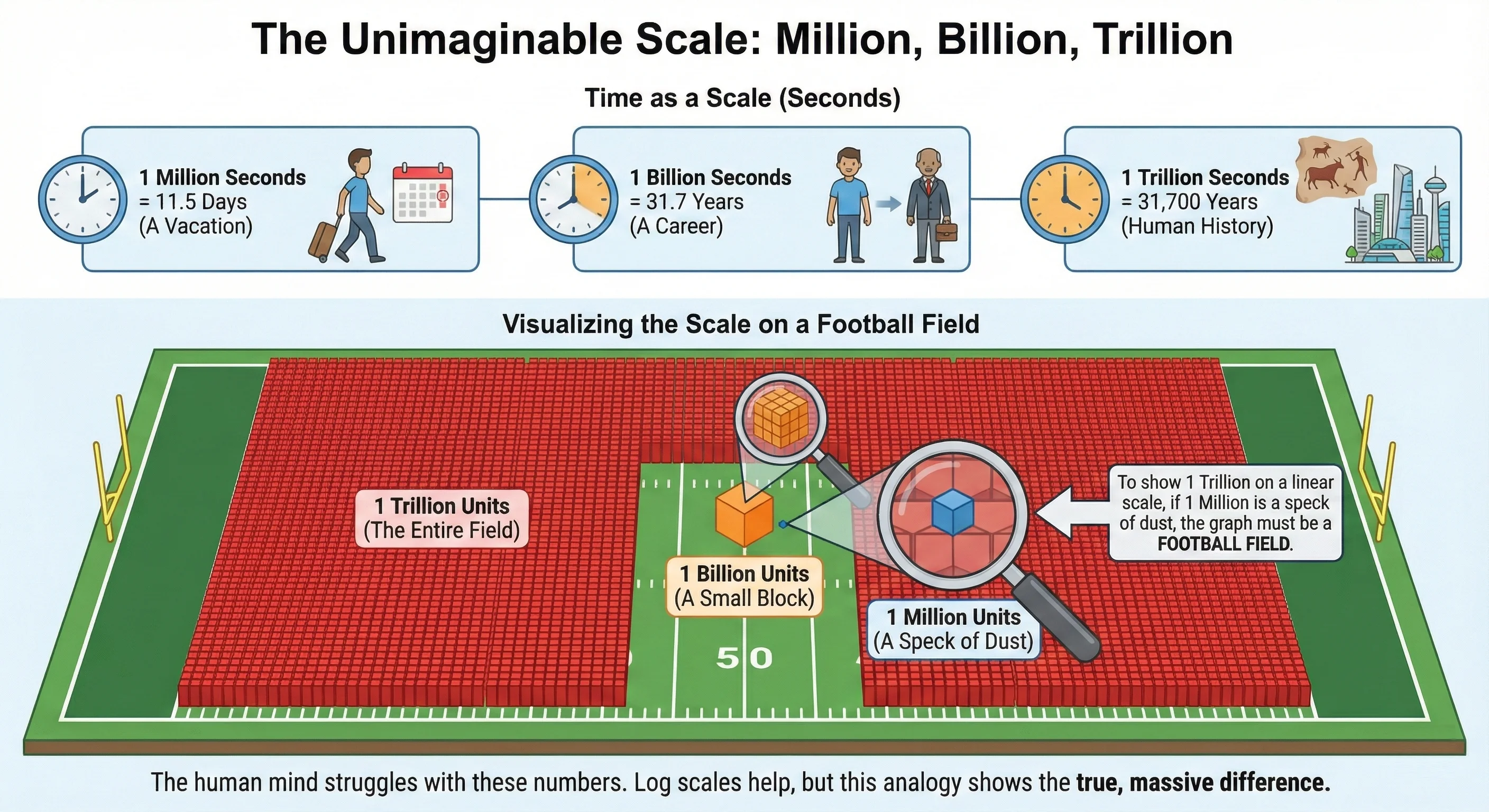
Consider this comparison:
- One million seconds equals about 11.5 days
- One billion seconds equals about 31.7 years
- One trillion seconds equals about 31,700 years
The jump from million to billion is not a small step. It is the difference between a week and a half versus an entire human lifetime. The jump from billion to trillion is the difference between one lifetime and all of recorded human history several times over.
Now apply this to the universe:
- The Milky Way galaxy contains roughly 100 to 400 billion stars[7]
- The observable universe contains roughly 200 billion to 2 trillion galaxies[8]
- This means roughly 40 billion trillion stars exist in the observable universe (conservative estimate)
Write that number out: 40,000,000,000,000,000,000,000 stars. Each of those stars is a potential host for planets. Current estimates suggest that most stars have at least one planet.[9] Many have several. The number of planets in the universe likely exceeds the number of stars.
Probability at Scale
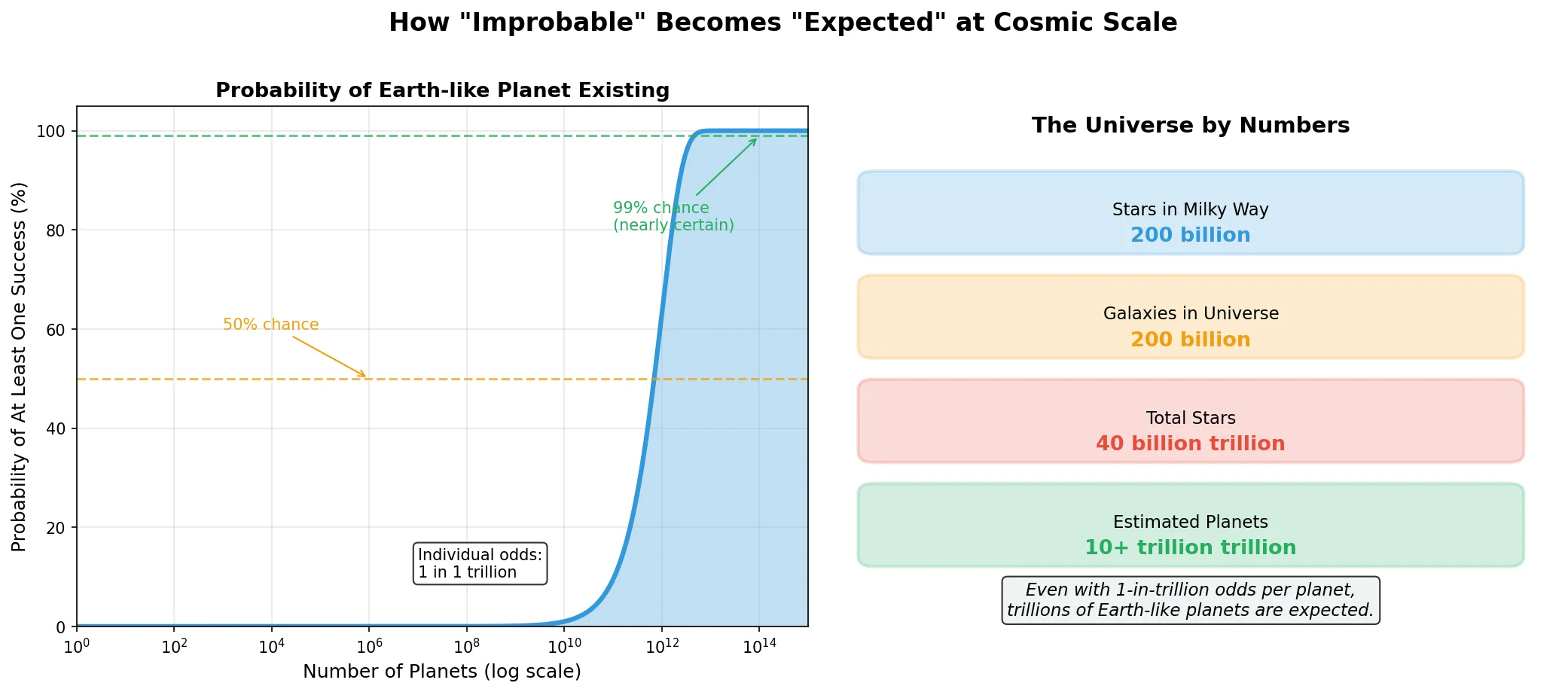
Imagine a lottery where the odds of winning are one in a billion. If one person buys a single ticket, winning is essentially impossible. But what if a billion people each buy a ticket? Suddenly, a winner becomes not just possible but expected. The individual odds remain terrible. The collective outcome becomes nearly certain.
This is how probability works at cosmic scale. Ross presents the odds of Earth-like conditions arising on any single planet as vanishingly small. Grant him that assumption. Even if the probability is one in a trillion, the universe contains enough planets to make such an outcome not just possible but likely.
Let us work through the math simply. Suppose the probability of a planet developing conditions suitable for complex life is one in one trillion (1 in 1,000,000,000,000). This seems impossibly small. Ross would likely argue the odds are even lower.
But the universe contains at least 10 trillion trillion planets (a conservative estimate based on current astronomical surveys).[9] Divide: 10,000,000,000,000,000,000,000,000 planets divided by 1,000,000,000,000 odds equals 10 trillion expected planets with suitable conditions.
Even with absurdly low probability per planet, the sheer number of planets makes life-bearing worlds not just possible but statistically expected. The universe is not playing the lottery once. It is playing trillions of trillions of times. Someone wins.
How Life Actually Emerges
Ross frames the origin of life as a single improbable leap. Chemicals somehow become a living cell. When stated this way, the odds do seem impossible. But this framing misrepresents how scientists believe life actually emerged.
Life did not spring into existence fully formed. It developed through a series of smaller, more probable steps over hundreds of millions of years. Each step built on the previous one. No single step required a miracle.
How Polypeptides Actually Form
Ross makes claims about the impossibility of proteins forming naturally. To evaluate these claims, we need to understand what proteins are and how they form.
Proteins are chains of amino acids. A short chain is called a peptide. A longer chain is called a polypeptide. The chains fold into complex three-dimensional shapes that determine their function.

Amino acids form easily. The Miller-Urey experiment (1953) and many subsequent studies have shown that amino acids form spontaneously from simple chemicals under early Earth conditions.[10] They have also been found on meteorites, proving they form in space without any biological processes.[11] Amino acids are not rare or special. They are common products of basic chemistry.
Amino acids link together naturally. When amino acids are concentrated and heated, they form peptide bonds. This has been demonstrated repeatedly in laboratory settings.[12] The reaction is called dehydration synthesis: two amino acids join together, releasing a water molecule. No enzymes required. No cellular machinery. Just chemistry.
Crystal formation provides an analogy. Consider a snowflake. It has intricate, beautiful, complex structure. No one designed it. The complexity arises from the physical properties of water molecules and the conditions under which they freeze. Complexity does not require a creator. It can emerge from simple rules applied repeatedly.
Ross presents complexity as proof of design. But complexity is exactly what we should expect from chemistry operating over cosmic time scales. The numbers do not point to a Creator. They point to the ordinary workings of physics and chemistry across an unimaginably vast universe.
The Cost of Convenience
Why does any of this matter? Ross is one author among many in the crowded field of apologetics. Why spend time and thousands of words dissecting his methodology?
The answer is that Ross's approach creates real harm. It teaches readers to distrust their own judgment. It models a way of thinking that opens doors to manipulation. And it presents suffering as divinely designed in ways that blame victims for their own tragedies.
The Illusionist's Gateway
Study the techniques used by cult leaders and manipulative religious teachers. A pattern emerges. They position themselves as the sole authentic interpreter of truth. They claim access to knowledge that ordinary people cannot obtain on their own. They teach their followers to distrust outside sources of information. And they provide a framework that explains everything, leaving no room for doubt or questioning.
Ross does not run a cult. He is not Jim Jones or David Koresh. But his methodology follows the same structural pattern that cults exploit.
Consider how Ross positions himself. He claims to honor both science and scripture. But he also claims that most scientists misunderstand the implications of their own research and that most Christians misread their own Bible. The scientific community gets evolution wrong. Young-earth creationists get the age of the universe wrong. Atheists miss the obvious evidence for design. Only Ross and his organization, Reasons to Believe, correctly synthesize all the evidence.
This is not humility. It is a claim to unique interpretive authority.
Warning Signs of Manipulative Methodology
- Claim to exclusive truth: Ross claims his "day-age" interpretation uniquely harmonizes science and faith.
- Distrust of outside authorities: Ross teaches readers to distrust both biblical literalists and mainstream scientists.
- Complex explanations for simple texts: Ross reinterprets "day" to mean "age," "evening and morning" to mean something other than evening and morning.
- Leader as interpretive authority: Ross positions himself as the arbiter of which scriptures to take literally and which to reinterpret.
- System that explains everything: Ross's framework claims to integrate all scientific and biblical data into a seamless whole.
Again, Ross is not running a cult. The comparison is structural, not moral. But when you teach people to distrust plain readings of texts and to defer to an expert interpreter, you create exactly the psychological conditions that cults exploit. You remove the guardrails that protect people from manipulation.
The False Dichotomy
Ross repeatedly frames his approach as a reasonable middle path. He is not a young-earth creationist who ignores science. He is not an atheist who ignores faith. He takes both seriously, studying natural explanations while remaining "open to supernatural causality."
In Improbable Planet, Ross writes that "supernatural causality warrants respectful consideration by scientists, rather than immediate and unquestioning dismissal."
This sounds balanced. It sounds fair. It is neither.
Science and supernatural explanation are not equivalent alternatives. They are not two equally valid methods for understanding reality that deserve equal consideration. One of them has produced the modern world. The other has produced nothing.
The scientific method works because it demands evidence, tests hypotheses, and discards ideas that fail experimental scrutiny. It builds on itself, correcting errors over time. It gave us medicine, technology, and accurate predictions about the physical world. We can measure its success by the results it produces.
Supernatural explanation produces no testable predictions, corrects no errors, and builds nothing. It has never cured a disease, predicted an eclipse, or built a bridge. This is not bias against religion. It is an observation about what supernatural claims actually accomplish in terms of understanding the physical world.
Natural Evil and Victim Blaming
Perhaps the most troubling aspect of Ross's methodology appears in his treatment of natural disasters.
In Chapter 16 of Improbable Planet, Ross describes hurricanes, tornadoes, earthquakes, floods, and fires as "so-called natural evils." He argues that these events "all played (and still play) a valuable role establishing and maintaining Earth's optimal habitability." Disasters are not bugs in creation. They are features. God designed them for a purpose.
Then Ross writes something remarkable:
"More often than not, humanity's lack of respect for, or understanding of, nature's forces puts people in harm's way."
Read that again carefully. Ross is saying that when people die in earthquakes and hurricanes, it is often their own fault. They failed to respect nature. They failed to understand the forces that killed them. The tragedy is not that a tsunami drowned a coastal village. The tragedy is that the villagers did not know better than to live there.
This is victim blaming dressed in theological language.
Consider what this means in practice. When an earthquake strikes Haiti and kills hundreds of thousands of people, are we to believe they should have known better? When a cyclone devastates Bangladesh, is the problem that poor farmers failed to "respect" the storm? When children die in floods, did they lack sufficient "understanding" of nature's forces?
Natural disasters kill approximately 40,000 to 50,000 people per year on average.[13] The argument also fails theologically. If God is omnipotent, as Ross believes, then God could maintain Earth's habitability without killing tens of thousands of people per year in natural disasters. An all-powerful being is not constrained by engineering tradeoffs. God does not need earthquakes to circulate nutrients or hurricanes to regulate temperature. The choice to design a world where such events kill innocent people is a choice, not a necessity.
Ross wants to defend God's design. But in doing so, he makes suffering into a feature rather than a problem. The people who die become complicit in their own deaths through ignorance or disrespect. This is not theodicy. It is apologetics for catastrophe.
Conclusion
Hugh Ross claims to honor both science and scripture. He positions himself as a bridge between faith and evidence, a guide for those who want to believe without abandoning reason. Improbable Planet presents itself as that bridge: a scientifically informed case for creation that takes the data seriously.
But the bridge is an illusion.
Throughout this paper, we have traced a consistent pattern. Ross selectively accepts scientific findings when they support his predetermined conclusions. He dismisses or misrepresents those same findings when they do not. He cites decades-old research when current studies would complicate his argument. He speaks authoritatively about fields where he has no credentials. He misrepresents how origin-of-life science actually works, attacking a strawman version instead of the real theory.
The same pattern appears in his treatment of scripture. Ross assumes that "day" does not mean "day" in Genesis, but he offers no consistent method for determining when scripture should be reinterpreted and when it should be taken literally. His framework creates theological contradictions he never addresses, like billions of years of death before the Fall. The common thread is not fidelity to either science or scripture. It is convenience. Whatever interpretation supports Ross's existing conclusions gets accepted. Whatever contradicts them gets explained away.
This matters because methodology matters. If you claim to follow evidence, your method for evaluating evidence must be consistent. You cannot accept one finding and reject another based on whether you like the implications. If you claim to respect scripture, your interpretation must follow discernible rules. You cannot make "day" mean "age" in one passage and "24 hours" in another without explaining why.
Ross fails these tests. His methodology is circular. He begins with his conclusion and works backward to find support for it. This is not scholarship. It is apologetics dressed as science.
The real cost of this approach is not just bad arguments. It is the thinking patterns it teaches. Readers who accept Ross's framework learn to distrust their own reading of texts. They learn to defer to an expert interpreter who claims special synthesis. They learn that mainstream science is wrong about origins but right about everything else. They learn to dismiss inconvenient evidence while embracing convenient evidence. These are the habits of credulity, not critical thinking.
We can do better.
Those who want to hold faith and science in dialogue should demand intellectual honesty from both sides. Science should be current, not selectively dated. Claims should stay within the speaker's expertise. Arguments should engage the strongest version of opposing views, not strawmen. Scripture should be interpreted by consistent rules, not ad hoc methods that shift based on desired outcomes. And suffering should never be swept under a theological rug where the victims are blamed for their own deaths.
The universe may or may not point to a Creator. That is a question each person must wrestle with. Reasonable people disagree, and the disagreement itself is not a failure. What is a failure is the methodology Ross employs: the selective evidence, the inconsistent interpretation, the false equivalences, and the convenient conclusions.
Improbable Planet does not help readers think more clearly about these questions. It tells them the answers have already been decided and that Ross is the authorized referee. But readers deserve better than a referee who makes the calls based on which team he wants to win.
The world is vast, ancient, and complex. Understanding it requires humility, consistency, and a willingness to follow evidence even when it leads somewhere uncomfortable. Ross offers certainty instead. That certainty comes at the cost of honest inquiry.
References
-
Hugh Ross Credentials
Wikipedia. "Hugh Ross (astrophysicist)." Hugh Ross received his Ph.D. in astronomy from the University of Toronto in 1973. He completed postdoctoral research at Caltech from 1973-1978.
https://en.wikipedia.org/wiki/Hugh_Ross_(astrophysicist) -
Hebrew Word "Yom"
Strong's Hebrew: 3117. The Hebrew word "yom" (יוֹם) occurs 2,282 times in the Old Testament and can refer to a day, days, or a period of time depending on context.
https://biblehub.com/hebrew/3117.htm -
"Yom" with Numbered Days
Brown-Driver-Briggs Hebrew Lexicon and Theological Wordbook of the Old Testament (TWOT). Standard academic Hebrew lexicons define "yom" in Genesis 1 as a regular "day as defined by evening and morning." The word appears 2,303 times in the Old Testament with various contextual meanings.
https://www.blueletterbible.org/lexicon/h3117/kjv/wlc/0-1/ -
Giant Impact Hypothesis
Space: Science & Technology. "Research Advances in the Giant Impact Hypothesis of Moon Formation." The giant-impact hypothesis is currently the favored hypothesis for lunar formation among astronomers.
https://spj.science.org/doi/10.34133/space.0153 -
Self-Replicating RNA
PNAS. "A self-replicating ligase ribozyme." (2002) Demonstrates RNA molecules that can promote their own synthesis, achieving exponential growth with an autocatalytic rate constant of 0.011 min⁻¹.
https://www.pnas.org/doi/10.1073/pnas.202471099 -
Spontaneous Lipid Vesicle Formation
PMC. "The Role of Lipid Membranes in Life's Origin." Formation of liposomes (vesicles) is an entirely physical process that occurs spontaneously when phospholipids are present in water.
https://pmc.ncbi.nlm.nih.gov/articles/PMC5370405/ -
Stars in the Milky Way
NASA Blueshift. "How Many Stars in the Milky Way?" NASA estimates the Milky Way contains between 100 billion and 400 billion stars, with 200 billion being a commonly cited middle estimate.
https://asd.gsfc.nasa.gov/blueshift/index.php/2015/07/22/how-many-stars-in-the-milky-way/ -
Galaxies in the Observable Universe
NASA Science. "Hubble Reveals Observable Universe Contains 10 Times More Galaxies Than Previously Thought." Original estimate was ~200 billion galaxies; 2016 research revised this to approximately 2 trillion galaxies.
https://science.nasa.gov/missions/hubble/hubble-reveals-observable-universe-contains-10-times-more-galaxies-than-previously-thought/ -
Exoplanet Estimates
Petigura, E. A., Howard, A. W., & Marcy, G. W. (2013). "Prevalence of Earth-size planets orbiting Sun-like stars." Proceedings of the National Academy of Sciences, 110(48), 19273-19278. The study found that approximately 11% of Sun-like stars harbor Earth-size planets in habitable zones, extrapolating to roughly 40 billion such planets in the Milky Way galaxy. Note: More recent estimates (e.g., NASA 2020) suggest ~300 million potentially habitable planets using refined criteria, though these newer studies were published after Ross's book (2016).
https://www.pnas.org/doi/10.1073/pnas.1319909110 -
Miller-Urey Experiment
Science. Miller, Stanley L. "A Production of Amino Acids Under Possible Primitive Earth Conditions." Science 117, 528-529 (1953). The foundational experiment demonstrating amino acid synthesis from simple chemicals.
https://www.science.org/doi/10.1126/science.117.3046.528 -
Amino Acids on Meteorites
Nature Scientific Reports. "A new family of extraterrestrial amino acids in the Murchison meteorite." (2017) The Murchison meteorite contains over 70 amino acids, with isotopic analysis confirming their extraterrestrial origin.
https://www.nature.com/articles/s41598-017-00693-9 -
Peptide Bond Formation Without Enzymes
PMC. "Formation of oligopeptides in high yield under simple programmable conditions." (2015) Demonstrates peptide bond formation from unactivated amino acids without catalysts, producing oligomers up to 20 amino acids long.
https://pmc.ncbi.nlm.nih.gov/articles/PMC4633627/ -
Natural Disaster Deaths
Our World in Data. "Natural Disasters." Disasters kill approximately 40,000 to 50,000 people per year on average over recent decades.
https://ourworldindata.org/natural-disasters -
RNA World Hypothesis
Alberts, B., Johnson, A., Lewis, J., et al. (2002). "The RNA World and the Origins of Life." Molecular Biology of the Cell (4th edition). New York: Garland Science. Explains how RNA molecules were capable of both storing genetic information and catalyzing chemical reactions before DNA and proteins evolved. Discusses ribozymes, self-replicating RNA, and natural selection among RNA molecules.
https://www.ncbi.nlm.nih.gov/books/NBK26876/ -
Protocell Research
Szostak Lab, Harvard/University of Chicago. "Replicating Vesicles." Research demonstrating that protocells can grow, divide, and undergo cycles of replication without complex cellular machinery.
https://voices.uchicago.edu/szostaklab/research/replicating-vesicles-2/ -
Age of the Universe
European Space Agency (2013). "Planck reveals an almost perfect Universe." ESA's Planck spacecraft measured the cosmic microwave background radiation with unprecedented precision, determining the age of the Universe to be 13.82 billion years. This represents the most precise measurement available from direct observation of the earliest light in the cosmos.
https://www.esa.int/Science_Exploration/Space_Science/Planck/Planck_reveals_an_almost_perfect_Universe -
2008 Miller-Urey Reanalysis
Science. Johnson et al. "The Miller Volcanic Spark Discharge Experiment." (2008) Reanalysis of original 1950s samples using modern techniques revealed 22 amino acids were produced, far more than originally reported.
https://www.science.org/doi/10.1126/science.1161527 -
Habitable Exoplanets
SETI Institute. "How Many Habitable Planets are Out There?" Based on Kepler data, an estimated 300 million potentially habitable planets exist in the Milky Way galaxy alone.
https://www.seti.org/press-release/how-many-habitable-planets-are-out-there -
Improbable Planet (Primary Source)
Ross, Hugh. Improbable Planet: How Earth Became Humanity's Home. Baker Books, 2016. ISBN: 978-0801016899.
https://support.reasons.org/purchase/improbable-planet
Scripture References
All scripture quotations are from the New Revised Standard Version Updated Edition (NRSVUE) via Bible Gateway:
- Genesis 1 - The creation account
- Genesis 2:2 - God rested on the seventh day
- Genesis 3 - The Fall and curse
- Genesis 7:24 - The flood duration
- Genesis 22:4 - Abraham's journey
- Exodus 12:15 - Passover instructions
- Exodus 24:16 - Moses on Mount Sinai
- Romans 5:12 - Death through sin
Additional Sources Consulted
- World Meteorological Organization. "Weather-related disasters increase over past 50 years." wmo.int
- PNAS. "Exploring exoplanet populations with NASA's Kepler Mission." pnas.org
- UC San Diego. "On the Origin of Life: How the First Cell Membranes Came to Exist." ucsd.edu
- NASA Astrobiology. "Miller-Urey Revisited." nasa.gov
- PNAS. "Amplification of RNA by an RNA polymerase ribozyme." (2016) pnas.org
- University of Chicago News. "How the Earth and moon formed, explained." uchicago.edu
- Britannica. "Miller-Urey experiment." britannica.com
- PNAS. "Nonprotein Amino Acids in the Murchison Meteorite." (1971) pnas.org
- American Museum of Natural History. "Milky Way Galaxy." amnh.org
- Natural History Museum. "How did the Moon form?" nhm.ac.uk